

What Are the Best Robotic Handling Systems in China?

China has become the world’s most important testing ground for robotic handling systems. In a modern factory, these systems move cartons, trays, components, and finished products with controlled speed. They also connect conveyors, vision cameras, grippers, software, and warehouse equipment.

The International Federation of Robotics reported 276,288 industrial robot installations in China during 2023. This represented about 51% of global installations that year. Its World Robotics 2024 report also recorded more than 1.7 million industrial robots operating in Chinese factories. These figures show scale, but scale alone does not identify the best solution. A high-volume automotive line needs different handling equipment from an electronics plant handling fragile circuit boards.

“China is the world’s largest robot market and has been for ten years,” said Marina Bill, President of the International Federation of Robotics. Her observation explains why global suppliers and Chinese integrators compete so actively in this market. Recent data from IFR and market research firms such as Interact Analysis also points toward stronger demand for integrated automation, machine vision, and flexible material movement.

The best robotic handling systems in China should therefore be judged by more than robot speed. Reliability, payload accuracy, safety design, service response, software compatibility, and lifetime operating cost matter equally. A system that saves seconds but causes frequent stoppages may be the wrong investment.

The choice is rarely obvious.

This guide compares leading system types, suppliers, and application strengths. It also recognizes an uncomfortable truth: published rankings can oversimplify real factory performance. A careful buyer must test cycle times, inspect maintenance records, and validate results under actual production conditions.
What Are the Best Robotic Handling Systems in China?

What Are Robotic Handling Systems and How Do They Work?

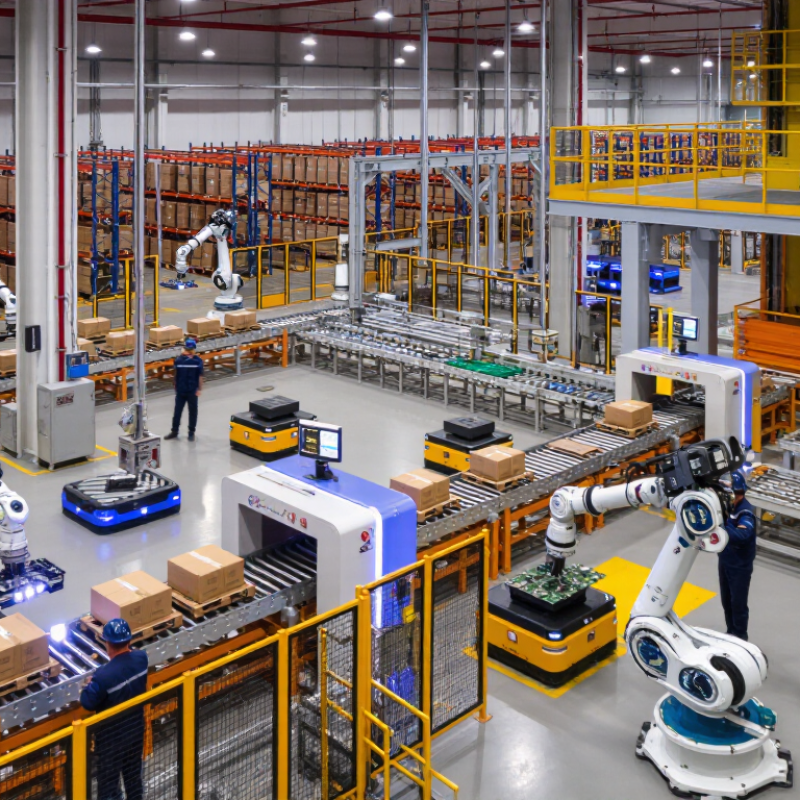
Robotic handling systems move, pick, place, sort, or position materials with programmed precision. They may handle cartons, metal parts, food containers, or delicate components. A typical system includes a robotic arm, gripper, sensors, controller, conveyor, and safety enclosure.

The process begins with an instruction from the control system. A camera or sensor identifies an object’s location, shape, and orientation. The controller then calculates a movement path. The arm reaches the item, closes its gripper, and transfers it to a selected station.

Feedback sensors check pressure, distance, and position during movement. If the object shifts, the system can slow down or correct its path.

The process looks simple. It is not always simple.

In Chinese factories, the best handling systems usually fit the production line rather than operate alone. Engineers examine payload, cycle time, floor space, product variation, and maintenance access. A vacuum gripper may suit sealed cartons, while mechanical fingers may handle uneven metal parts. Automated guided vehicles can move loads between workstations, but poor floor markings can reduce accuracy.

Reliable installation also requires guarded areas, emergency stops, speed limits, and verified operating procedures. Practical commissioning often reveals small weaknesses, such as a sensor blocked by dust or a gripper wearing faster than expected. These details matter. A system may perform impressively during testing, yet need better calibration for daily production. Operators should receive clear training, and maintenance records should track unusual noise, missed picks, and repeated stoppages.

Which Types of Robotic Handling Systems Are Used in China?

What Are the Best Robotic Handling Systems in China?

China’s factories use several robotic handling systems, selected by load, speed, layout, and product fragility. Articulated robots handle cartons, sacks, trays, and components on flexible production lines. Palletizing cells stack cases in stable patterns, while depalletizing systems feed materials into conveyors or processing equipment. Gantry robots move heavier loads across fixed rails. They suit warehouses and plants with predictable paths. Delta robots handle lightweight items quickly, especially packaged consumer goods. AGVs and AMRs transport pallets between storage, production, and dispatch areas. Their navigation may use magnetic tracks, QR markers, or LiDAR.

Collaborative robots are also used for smaller handling tasks near workers. They can load machines, sort parts, or transfer products between workstations. Vision cameras help identify position, orientation, and missing items.

Vacuum grippers suit smooth cartons, while mechanical grippers offer stronger control for irregular loads. In practice, integration quality matters more than robot type alone. A fast arm can still underperform when conveyors pause or pallets shift.

Small errors matter. Maintenance access is often underestimated. Dust, humidity, and changing carton sizes can reduce reliability, so engineers should test real materials before approval.

Tips: Measure actual cycle time, not brochure speed. Check payload, reach, safety zones, and floor strength. Keep manual recovery procedures available. Review data after installation, because the first layout is rarely perfect. Test product changes early.

What Industries Use Robotic Handling Systems Most Effectively?

Robotic handling systems are most effective where products move repeatedly, quickly, and with consistent presentation. In China, automotive plants use robots for part loading, welding transfer, palletizing, and inspection. Operators can reduce lifting injuries while maintaining stable cycle times across long production shifts. Steel frames, engine blocks, and battery components require different grippers and carefully controlled force. Small errors matter.

Electronics factories also gain strong results from compact robotic handling cells. These systems move circuit boards, screens, connectors, and delicate housings between assembly stations. Vision guidance helps locate parts that arrive slightly out of position. Clean movement protects fragile surfaces and reduces manual contact. However, excessive speed may increase dropped parts or alignment faults. A slower setting can sometimes deliver better output.

Food, beverage, pharmaceutical, and warehouse operations use robotic systems for sorting, case packing, depalletizing, and order preparation. Stainless-steel structures, washable designs, and traceable process records support strict hygiene requirements. Warehouses benefit when robots handle heavy cartons near conveyors and storage racks. Effective projects begin with verified cycle-time data, payload calculations, guarding, and operator training. Maintenance teams also need access to sensors, cables, and grippers. This is often overlooked. The best system is not always the fastest one; it fits the product, workspace, safety plan, and changing production demand.

How Do China’s Leading Robotic Handling Systems Compare?

China’s leading robotic handling systems differ less by appearance than by workflow control. In factory evaluations, autonomous mobile robots handle changing routes well. They use lidar, cameras, and fleet software to avoid blocked aisles. Automated guided vehicles remain stronger where paths are fixed and loads are predictable. Their guide infrastructure can reduce navigation uncertainty. Robotic arms add precision at transfer points, especially when cartons arrive unevenly. Payload ratings alone can mislead. A 1,000-kilogram rating means little when floor quality limits acceleration.

The clearest comparison uses measurable tasks. Check picks per hour, charging time, recovery after a stopped vehicle, and software response. Ask operators to test mixed pallets, narrow turns, dust, and temporary obstructions. Failures reveal more. Leading systems often provide modular interfaces for warehouse and manufacturing software. Yet integration quality varies. Some dashboards show impressive uptime while excluding manual interventions. That gap deserves scrutiny. Safety should include speed zoning, emergency stops, collision sensing, and documented risk assessments aligned with relevant international standards. Training and local maintenance also matter. A clever machine becomes expensive when spare parts wait weeks.

For high-volume warehouses, coordinated mobile robot fleets may outperform isolated vehicles. For repetitive production lines, guided vehicles and fixed robotic cells can offer steadier cycle times. Hybrid designs work when inbound and production areas behave differently. My caution is simple: demonstrations hide recovery work. Request a live pilot with recorded failures, not a polished video. Measure labor effort honestly, including supervision, exception handling, and battery changes. Record floor conditions, obstacle frequency, and operator response during each trial.

What Factors Should Buyers Consider Before Choosing a System?

What Are the Best Robotic Handling Systems in China?

Choosing a robotic handling system should begin with the material, not the robot. The International Federation of Robotics reported 276,288 industrial robot installations in China during 2023. That scale shows strong market maturity, but it does not guarantee a suitable application. Buyers should measure payload, cycle time, product variation, reach, and available floor space. Small details matter. A 300-millimeter positioning error can damage packaging flow.

End effectors deserve equal attention. Vacuum tools may suit cartons, while adaptive grippers handle irregular parts more reliably. Ask for test results using real products, including damaged cartons and dusty surfaces. Vision accuracy should be measured under actual lighting. Laboratory demonstrations can look perfect. Production floors rarely are.

Integration costs often exceed the initial equipment quotation. The MHI 2024 Annual Industry Report found that 55% of surveyed organizations planned to increase supply-chain technology investment, while workforce capability remained a major concern. Buyers should therefore examine software openness, operator training, spare-parts access, maintenance response, and cybersecurity controls. Request a total-cost model covering energy, tooling changes, downtime, and annual service. Also check compliance with current machinery-safety requirements, including ISO 10218 guidance. A common evaluation weakness is trusting projected return on investment without testing seasonal demand. That assumption needs challenging. A short pilot, with recorded cycle data, rejected units, and recovery time, provides more dependable evidence than a polished sales presentation.

What Are the Best Robotic Handling Systems in China? - What Factors Should Buyers Consider Before Choosing a System?

Robotic Handling System Typical Payload Typical Reach / Coverage Common Applications Main Advantages Key Limitations
Articulated Robot Handling Cell 3–500 kg, depending on configuration Approximately 0.5–3.2 m reach Palletizing, machine tending, loading and unloading, welding, packaging High flexibility, large working envelope, suitable for multiple axes and complex movements Requires safety fencing or equivalent safeguarding; programming and integration may be more complex
SCARA Handling System 1–20 kg in common configurations Approximately 0.3–1.0 m horizontal reach High-speed assembly, sorting, insertion, dispensing, small-part transfer Fast cycle times, strong repeatability, compact footprint and relatively simple maintenance Less suitable for heavy loads, large vertical travel or highly variable orientations
Delta Picking Robot 0.1–8 kg, depending on arm design Usually 0.4–1.6 m diameter work area Food packaging, pharmaceutical sorting, lightweight pick-and-place, high-speed inspection lines Very high picking speed, low moving mass and excellent performance on conveyor-based operations Limited payload and workspace; generally requires controlled conveyor presentation
Collaborative Robot Handling Cell 3–30 kg in common industrial models Approximately 0.5–1.8 m reach Small-batch assembly, inspection, machine tending, screwdriving, packaging Flexible deployment, easier redeployment and potential for shared workspaces after risk assessment Usually slower than dedicated industrial cells; collaborative operation does not eliminate safety requirements
Cartesian / Gantry Handling System 5–1,000+ kg, depending on frame and axis design Configured to the required X-Y-Z travel Pallet transfer, large-part loading, stacking, machining support, warehouse handling High rigidity, predictable motion, scalable travel and strong performance for heavy or oversized workpieces Larger installation area and less flexibility for irregular motion paths
Autonomous Mobile Manipulator 5–100 kg combined handling capacity, depending on mobile base and arm Navigation area is facility-dependent; arm reach commonly 0.7–1.8 m Line-side delivery, intralogistics, flexible kitting, multi-station material handling Reduces fixed conveyors, supports changing layouts and can serve several workstations Needs reliable navigation, floor access, traffic management, battery charging and fleet coordination

Buyer Evaluation Factors

Decision Factor What to Measure Why It Matters Recommended Buyer Check
Payload and Moment Product weight, gripper weight, center of gravity and wrist load A robot may meet the stated payload but fail when tooling and offset loads are included Request a payload calculation using the actual part, gripper and orientation
Cycle Time and Throughput Required cycles per minute, operating hours, changeover time and uptime target Nominal robot speed does not equal complete cell throughput Conduct an acceptance test with real parts and the complete end-of-arm tooling
Repeatability and Accuracy Required placement tolerance, fixture tolerance and measurement method Precision requirements vary significantly between palletizing, assembly and machining Separate robot repeatability from total system accuracy
Product Variation Number of product types, dimensions, surface conditions and changeover frequency High-mix production may require vision, recipe management or quick-change tooling Test the system with the full product range, not only the easiest part
Integration Capability PLC, MES, warehouse software, conveyor, sensor and machine communication requirements Poor integration can create bottlenecks and manual intervention Confirm supported industrial communication protocols and data ownership
Safety and Compliance Risk assessment, guarding, emergency stops, light curtains, scanners and operating modes Handling cells must be designed around the complete machine, not the robot alone Define applicable Chinese requirements and relevant international standards before installation
Total Cost of Ownership Robot, gripper, vision, fixtures, integration, training, energy, spares and maintenance The lowest purchase price may produce a higher long-term operating cost Compare five-year cost, expected uptime and consumable replacement requirements
Service and Spare Parts Local response time, spare-part availability, remote support and technician coverage Downtime costs can exceed the initial equipment price in continuous production Include response-time commitments, spare-part lists and service escalation procedures in the contract
Factory Conditions Temperature, dust, moisture, cleanroom needs, floor loading, available utilities and space Environmental conditions affect reliability, hygiene and component selection Verify protection ratings, installation clearances and utility consumption on site
Scalability Future volume, additional stations, software expansion and tooling changes A scalable platform reduces redesign costs as production grows Ask for expansion limits, spare I/O capacity and a documented upgrade path